The lack of cases of successful farms raising pigs without tail docking makes farmers, technicians and veterinarians skeptical about implementing these measures at the commercial level. In this section we describe the follow-up and experience of commercial farms that have taken the step of raising pigs with entire tails.
Recent years have seen increasing political pressure to implement the measures regarding the implementation of manipulable material on pig farms and the ban on routine tail docking stipulated in Directive 2008/120 / EC. Since 2016, the EU’s interest in effective implementation of the regulation has been growing, and audits have been carried out. Currently, several guides have already been edited in the EU to avoid tail biting, and thus facilitate the path towards compliance with the regulation. Among them we highlight the “Document on the management of pig farms to avoid tail biting” (MAPAMA) and in Catalonia, was published in April 2018,“the technical report for the prevention of caudophagy“.
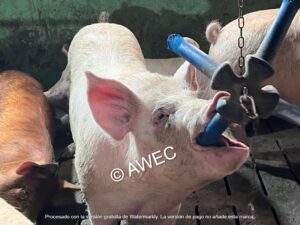
Examples of toys that are attractive as manipulative material for fattening pigs. It is important that the toys are hung at the level of the pigs’ noses and that they do not get dirty.
Despite increasing legislative pressure, great difficulties are observed on the part of producers to be able to implement these measures. The reasons why the vast majority of farms continue to raise pigs with docked tails are diverse, but most of them converge towards a common point: the fear of taking a substantial risk. The first risk is related to the nature of this behavioral problem: tail docking is a multifactorial problem, often sporadic and hardly predictable. The second risk is related to the supervision of the animals: stopping tail docking implies having a very good management and more time invested in the observation of the animals. The third risk is related to the economic costs involved in preventing the risk of tail biting.
The lack of cases of successful farms in raising pigs without tail docking makes farmers, technicians and veterinarians skeptical about the implementation of these measures on a commercial level.
In this section we describe the follow-up and experience of commercial farms that have taken the step to raise pigs with entire tails.
- what was the frequency of tail biting?
- Before tail docking is stopped: reducing chronic risk factors
- Manipulable material: a significant cost.
- The novelty factor: a key element in preventing tail biting
- Observing animals and anticipating a tail biting outbreak
Project funded through operation 01.02.01 Technology Transfer of the Catalan Rural Development Program 2014-2020.