As a trusful and sometimes misunderstood work companion, the Livestock Guardian Dog (LGD) safeguards the survival of many family farms. As part of a changing world, working with Livestock Guardian Dogs can be quite a challenge.
To understand these challenges and try to find solutions, a network has been created that connects shepherds and farmers from different areas in the world. Shepherds from localities in the Pyrenees, Transylvania and Chilean Patagonia have shared with us their knowledge of daily life with their dogs, their satisfactions, but also their concerns.
This activity is part of the PTQ2020 – 011034 grant funded by MCIN/AEI/ 10.13039/501100011033 and by the “European Union NextGenerationEU/PRTR”.
We hope that this network will keep on growing; each locality has their own reality and experiences to share.
If you want to participate and share experiences, do not hesitate to contact us.
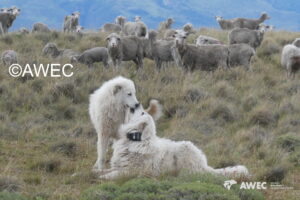
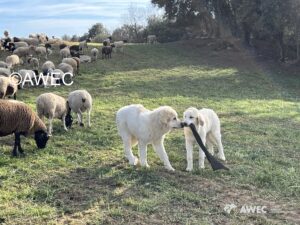
Livestock guardian dogs (LGDs) remain the most effective non-lethal strategy to reduce losses to predators including large wild carnivores and dogs. Besides the direct impact they have reducing damages from predation, shepherds also report that their livestock become calmer and are therefore easier to handle and more productive in the presence of LGDs. As a work companion, LGDs transmit self-security and emotional support to tthe shepherds and farmers.
However, despite the efficacy and widespread use of LGDs, many farmers still struggle to raise these dogs.
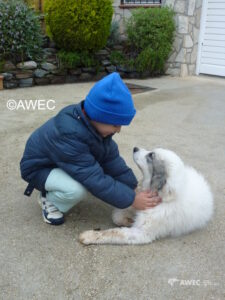
In particular, the socialisation of LGDs is essential to prevent aggression towards people and must be balanced against the need for dogs to bond with livestock. Finding this balance is especially important in tourist-heavy areas.
“A Livestock Guardian Dog can fulfil the role of livestock protector and be sociable and friendly with thoughtful people”
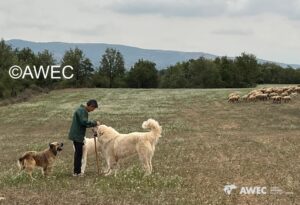
Poor selection of working lines, inappropriate crossbreeding and poor training techniques are additional major obstacles to the successful work of LGDs.
Finally, the general public often does not know how to behave in the presence of LGDs, which can lead to conflicts between different mountain users.
We have been working with shepherds and farmers in the Pyrenees for years. Over time and given the opportunity, we have found essential to be able to gather experiences and knowledge from other areas: places with different realities, different herd management systems, different breeds, different pastures, different predation.
So far, we visited shepherds and farmers in Transylvania and in Chilean Patagonia. They shared with us their knowledge of the day-to-day life with their dogs, their satisfactions, but also their concerns. Below are some of the results.
Visited shepherds were highly satisfied by the efficiency of their dogs against predators.
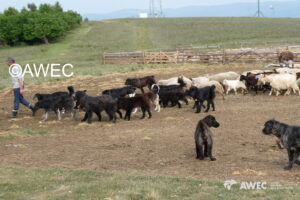
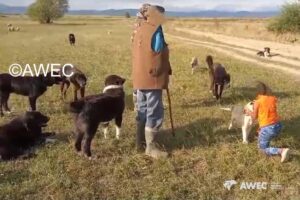
On Transylvanian farms, an average of 14 LGDs worked together with 4 shepherds present 24h/7 to protect 424 sheep/goats. The main predator for these farms is the bear, followed by wolves. Shepherds face the following challenges related to the work of LGDs: LGD mortality due to predator attacks, pack management during heats, aggressions towards foreign-owned dogs.
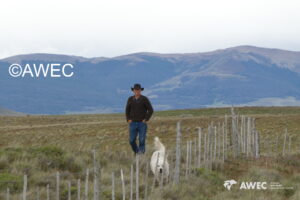
In Chilean-Patagonia herds, an average of 6 LGDs protected 6.552 sheep in 16.133 ha with no reference shepherd figure and parturitions outside. The main predator for these ranches is the fox, followed by the puma and the dog. Main challenges are playing and harassing lambs when the LGD is young, LGDs roaming to other herds, feeding management of LGDs and LGDs who do not want to be grabbed.
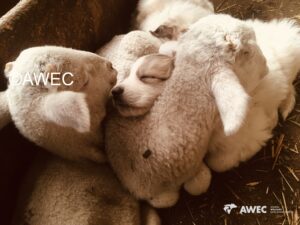
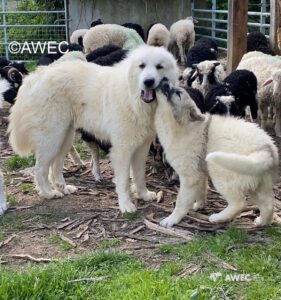
On the visited farms in the Pyrenees, herd management consisted in shepherding and/or electric fences with an average of 2 LGDs protecting 430 sheep/goats. Main predators were owned dogs followed by the bear and the wolf. Vet and food expenses, heat stress and conflicts related to high proximity between pasture lands and people are the main challenges.
The shepherds and ranchers visited in the Pyrenees and in Chilean Patagonia emphasize that training and guiding LGDs are especially complicated and intense during the first 2 years.
From these visits, several critical points have been highlighted to ensure working with a well-balanced livestock guardian dog:
- Ensure good socialisation with people from puppyhood.
- The puppy has to grow up among lambs, goats and other farm animals
- The puppy learns from his mother, his siblings and other livestock guardian dogs
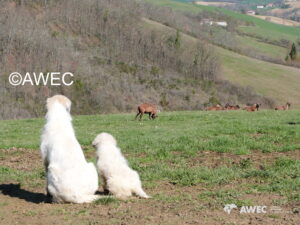
- Have at least two LGDs; avoid introducing a puppy alone into a herd.
- Good working genetic lines help
- It is essential to establish a bond of respect and collaboration between the shepherd and his/her LGDs
- Always use breeding techniques based on positive reinforcement. It is totally counterproductive to use punishment
- LGDs require time and patience
- A LGD is a work companion; not a tool.
We hope that this network will keep on growing; each locality has its own reality and experiences.
If you want to participate and share your experiences, please contact us.
Special thanks to the Rural Agents of Catalonia, Kaiku Borda, le Hogan des Vents, Boti Zoller and José Antonio Kusanovic.
This activity is part of the PTQ2020 – 011034 grant funded by MCIN/AEI/ 10.13039/501100011033 and by the “European Union NextGenerationEU/PRTR”.